Granada Flamenco Biennial, Festivals, and Dance Classes
The smell of damp stone and crushed jasmine always hits first when you walk up the Albaicín after dark. Then comes the sharp wooden crack of heels against pine boards, echoing off white walls that have soaked up music for centuries. If you time your visit around a major festival flamenco granada, that sound is not tucked away in tourist taverns. It spills out into courtyards, sweeps across outdoor amphitheaters, and vibrates through the floorboards of studios where people from Tokyo to Toronto spend four hours a day trying to make their wrists move with genuine intention.
Granada has an complicated relationship with flamenco history. Seville gets the international press and the massive commercial infrastructure, but Granada gave the world the 1922 Concurso de Cante Jondo, organized by Federico García Lorca and Manuel de Falla. That singular event rescued deep Andalusian song from cheap cafe entertainment and treated it as high art. Today, the city honors that legacy through a mix of historic showcases, brand-new performance initiatives, and an array of dance schools tucked along steep hillside alleys.
Book your flamenco show granada experience:
The Arrival of the Granada Flamenco Biennial
For decades, locals grumbled that Seville had its world-famous festival while Granada lacked a unified marquee event to celebrate its distinct gypsy traditions. That shifted with the launch of the primera bienal de flamenco de granada. The inaugural edition, the 1 bienal de flamenco granada held in autumn 2024, brought an ambitious slate of performances to landmark city stages. Billed across town as the bienal flamenco granada 2024, it laid down a serious artistic marker. Venues like the Teatro Isabel la Católica and various historic plazas filled with fans hungry for pure cante and avant-garde staging.
The buzz surrounding the bienal de flamenco granada 2024 proved there was massive appetite for an alternating calendar. Now, the momentum carries into planning for the bienal de flamenco de granada 2025 and future iterations. The organizers deliberately contrast big theater showcases with intimate recitals in atmospheric settings. You might catch an austere solo guitarist inside an old monastery cloister at noon, followed by a full company staging a dramatic theatrical production downtown at 9:00 PM.
Note: Program schedules for the bienal flamenca granada can be published late, sometimes just six or eight weeks before opening night. Keep your travel dates flexible if you want to book tickets for specific headliners.
What makes the granada flamenco biennial unique is its deep tether to local geography. The artists are not performing in sterile convention centers. They play against backdrop vistas of the illuminated Nazrid palaces. For any traveler who appreciates raw musicianship over polished arena pop, attending the bienal de flamenco de granada offers a look at how contemporary artists reinterpret ancient rhythms like the granaina and the tango de Granada without losing their soul.
Summer Magic: Festival Flamenco Alhambra Granada and Generalife
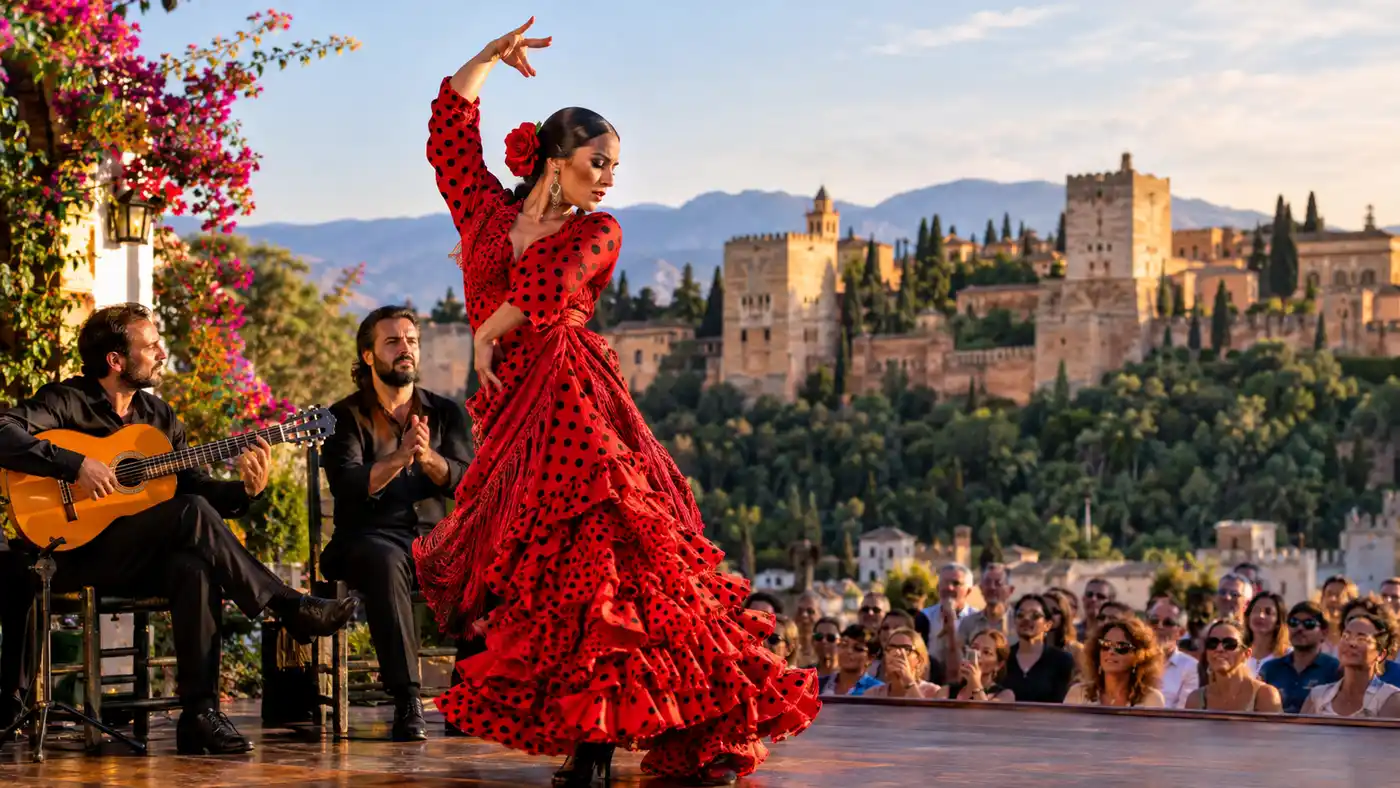
Summers here get hot. The pavement radiates heat until well after sunset, which is why open-air evening programming dominates July and August. The undisputed highlight of the seasonal calendar is the annual program staged under the stars at the Generalife gardens, often known colloquially among travelers as the festival flamenco alhambra granada. The setting alone justifies the ticket price. You walk through tall cypress hedges, past fountains murmuring in the warm night air, and take your seat in an amphitheater carved right into the palace grounds.
The "Lorca y Granada en los Jardines del Generalife" series presents full-scale narrative dance works inspired by the poetry and drama of Lorca. Seeing flamenco generalife granada productions means watching thirty dancers move in tight synchronization while the Alhambra walls loom overhead against an indigo sky. The lighting design usually plays off the natural earth tones of the palace masonry. It feels cinematic, yet the sound of the percussion is immediate and earthy.
Running alongside or just before the Generalife season is the prestigious Festival Internacional de Música y Danza de Granada. This gathering blends classical symphonies with serious flamenco granada alhambra performances. You might find a master guitarist sitting alone in the renaissance courtyard of the Palace of Charles V, coaxing impossibly delicate harmonies out of six nylon strings. Tickets for these specific shows vanish within hours of going live, usually in early spring.
| Event / Series | Usual Timing | Primary Venues | Approximate Entry | Atmosphere |
|---|---|---|---|---|
| Lorca y Granada (Generalife) | July to late August | Teatro del Generalife | €20 to €38 | Theatrical, grand scale, balmy outdoor garden setting |
| Festival de Música y Danza | Late June into July | Palacio de Carlos V, Generalife | €25 to €75 | Prestigious, formal, world-class acoustic environments |
| Los Veranos del Corral | Late July / early August | Corral del Carbón | €16 to €22 | Intimate, stark, historic 14th-century courtyard |
| Bienal de Flamenco de Granada | Autumn (biennial) | Teatro Isabel la Católica, Carmen venues | €18 to €45 | Curated, varied, mix of pure cante and modern choreography |
Courtyard Recitals and the Spirit of Fiesta Flamenca Granada
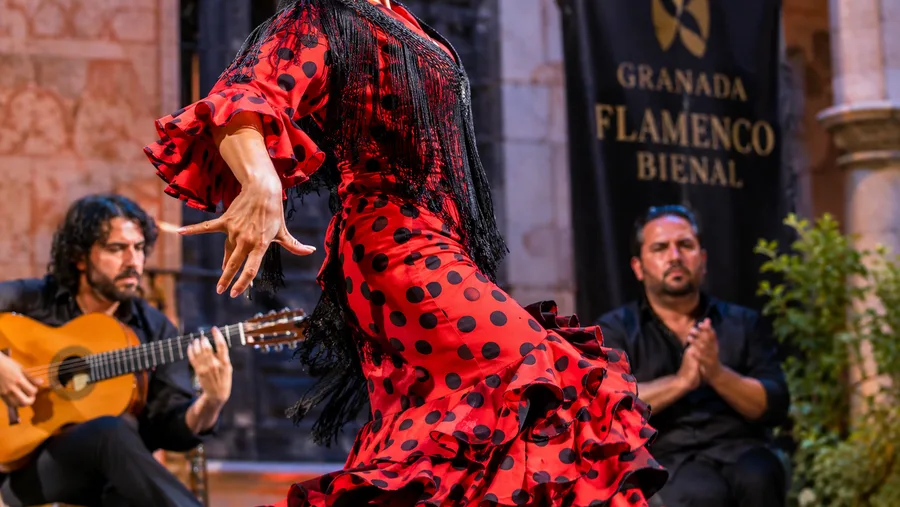
Beyond the huge festivals with five-figure production budgets, Granada hides smaller seasonal gems that I personally prefer. One of them is Los Veranos del Corral, hosted inside the Corral del Carbón. The building is a 14th-century Nasrid caravanserai tucked down a tiny alley off Calle Reyes Católicos. It has a stone courtyard surrounded by wooden galleries where merchants once slept. On summer nights, a wooden platform goes up in the center. There are roughly 150 folding chairs, zero amplification tricks, and nowhere for an insecure performer to hide.
The acoustics inside that stone enclosure are dry and punchy. You hear the breathing of the singer, the scrape of the thumbnail on the lower guitar strings, and the sharp hiss of breath as the dancers signal tempo shifts. It represents an older style of fiesta flamenca granada, stripped of digital smoke effects and high-concept staging.
Pro tip: Arrive at the Corral del Carbón at least 35 minutes before showtime. Seating inside the small courtyard is unassigned, and the front two rows give you an unobstructed view of the footwork.
If your trip coincides with early May, you run directly into the Día de la Cruz. Neighborhood associations, schools, and social clubs construct elaborate flower crosses in plazas throughout the Albaicín and Realejo. Each cross gets flanked by copper pots, embroidered Manila shawls, and an impromptu sound system. Spontaneous rumbas and sevillanas break out on cobblestone corners. It feels less like a formal granada flamenco festival and more like a neighborhood block party where half the grandmothers can out-dance professional touring troupes.
- Corral del Carbón courtyard: Best for purists wanting close-up views of foot technique without microphones.
- Plaza San Nicolás terraces: Best for catching buskers jamming at sundown with cheap cajóns and fiery vocals.
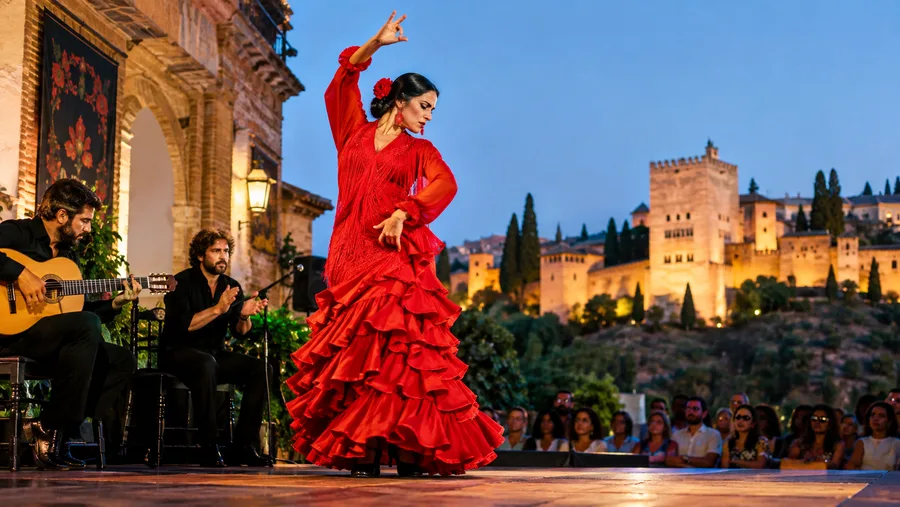
- Palacio de los Córdova: Best for open-air festival flamenco de granada galas that frame the Alhambra in evening light.
- Peña La Platería: Best for Thursday night club sessions inside the oldest flamenco cultural association in Spain.
Book your flamenco show granada experience:
Booking Clases de Flamenco Granada: Studios and Intensive Cursos
Watching performances every night usually makes people want to learn the mechanics themselves. Granada is one of the premier destinations in Europe for dance study, right up there with Jerez and Seville. Enrolling in clases flamenco granada offers an immediate, humbling appreciation for what the professionals do. It looks fluid on stage, but flamenco is essentially percussive mathematics executed while keeping your torso upright and your face relaxed.
The city's most famous institution is Carmen de las Cuevas, situated on the slopes of the Albaicín. They have operated since 1981, offering combined language and dance programs. The studios have floor-to-ceiling windows looking directly across the Darro valley to the Alhambra towers. Stepping inside those studios during summer intensive cursos flamenco granada means hearing six metronomes clicking at different tempos while dancers work through footwork drills until sweat drips off their jawlines.
Another powerhouse is the Escuela de Flamenco Lucía Guarnido, located near the city center. They cater to everyone from complete novices taking introductory workshops to advanced professionals polishing specific choreographies. For people seeking a deeper cultural link, heading further up into Sacromonte brings you to spaces like the Escuela Manolete, founded by the revered maestro Manuel Santiago Maya. Studying there connects you to the pure Gitana styling native to the flamenco caves of Sacromonte, where dance posture tends to be grounded, earthy, and fiery.
- Wear the correct gear: Do not show up in running sneakers; you need hard-soled shoes with thick heels, preferably pegged flamenco shoes, to avoid destroying your achilles tendons.
- Focus on compás first: Beginners waste energy trying to jump into fast foot stomping, but learning to clap accurate palmas on the 12-beat cycle is what teachers actually care about.
- Choose weekly intensive formats: If you only have seven days, book a package with 90 minutes of technique and 90 minutes of choreography daily rather than sporadic drop-ins.
- Ask about guitar accompaniment: The top studios bring in a live guitarist for the final two days of class so students learn how to communicate cues in real time.
Taking clases de flamenco granada changes how you watch evening shows. You suddenly recognize the subtle syncopation of the palmeros. You notice when a singer stretches a phrase across a bar line to challenge the dancer. You understand why an artist smiles when the guitarist drops down into a sudden falseta. It transforms you from a passive spectator into an educated listener.
Navigating the Granada Festival Scene Like a Local
Going to a festival de flamenco granada requires practical forethought, mostly because the city was designed by medieval Moors who cared about defensive barriers rather than crowd flow. A lot of travelers book an 8:30 PM show in the Albaicín, look at a map, assume it is an easy ten-minute stroll from Plaza Nueva, and end up sweating through their linen shirts while panting up a 20-degree incline paved with polished river stones.
Wear flat shoes for walking, even if you brought nice heels for the performance. Slip the nice shoes into a tote bag and change at the venue door. Taxis will not take you down certain historic pedestrian corridors, and the tiny red microbuses (lines C31 and C32) become packed around dusk when festival curtains approach.
Eating times also trip people up. In Granada, dinner before 9:00 PM is almost nonexistent outside of tourist burger spots. Because festival shows routinely kick off at 9:30 or 10:00 PM and run for two solid hours, you face a tactical choice: eat tapas at 7:30 PM right when bars open their kitchen fryers, or plan for a midnight meal after the curtain falls. Tapas joints around Campo del Príncipe or Calle Navas stay lively well past 1:00 AM, making post-show debriefs over wine and fried squid a regular ritual.
If you want to purchase passes for official programs like the Alhambra festival or city theater schedules, avoid third-party resale portals that charge 40% markup fees. Use the municipal platform RedEntradas or the official website of the patronato organizing the specific festival. For small peña shows and studio presentations, buying paper tickets at the door an hour before showtime is often the only way, cash in hand.
Frequently Asked Questions about festival flamenco granada
When is the best time of year to visit Granada for flamenco festivals?
Late spring through mid-summer offers the dense concentration of events. June and July feature the Festival Internacional de Música y Danza, followed by the Lorca y Granada season at the Generalife amphitheater throughout August. The biennial events take place in late summer or autumn.
Can complete beginners enroll in dance classes in Granada?
Yes. Prominent academies like Carmen de las Cuevas and Escuela Lucía Guarnido offer dedicated beginner tracks year-round. These classes break down basic posture, palmas (handclapping rhythms), and simple zapateado foot patterns without expecting prior dance experience.
Are Generalife summer shows suitable for children?
Older kids who can sit through 90 minutes of narrative theater usually love the costumes, lighting, and dramatic music. The performances begin quite late at night, usually around 10:00 PM, which might test the patience of toddlers or younger children.
Do I need to dress up formally for festival shows?
Attire is smart-casual. You will see locals wearing neat summer dresses, tailored trousers, or collared linen shirts. Extreme formal wear like black-tie is unnecessary, but showing up in beach shorts and flip-flops will make you stand out awkwardly at indoor theaters or palace courtyards.
Quick Reference
- Major open-air venue: Generalife Gardens (Alhambra)
- Prime season: Late June through August
- Famous historic club: Peña Flamenca La Platería (est. 1949)
- Top studio for short courses: Carmen de las Cuevas (Albaicín)
- Ticket booking: Use RedEntradas or official venue box offices
Book your flamenco show granada experience:
Before You Pack Your Dancing Shoes
Granada has a way of staying in your blood long after you leave the shadow of the mountains. Whether you come to sit in the fragrant gardens of the Generalife watching thirty dancers trace Lorca's ghost across the stage, or to lock yourself in an Albaicín dance studio until your calves ache, the city demands your full attention. Skip the polished commercial dinner tours, check the seasonal performance calendars early, and make time to sit in an ancient courtyard where the only sound is wood hitting wood and a voice crying out into the cool mountain night.
Read more about flamenco show granada.